
Glass, metal and precast restoration on an Arlington office building
Algae on the stone, corrosion on the frames, and mineral staining heavy enough that the glass had to be stripped before it could be polished.
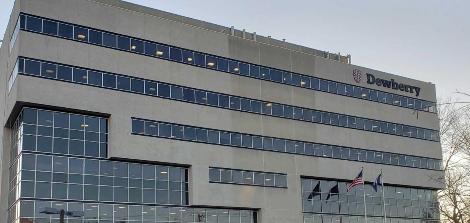
8401 Arlington Blvd is a commercial office building in Arlington, Virginia. The facade is mostly architectural glass and precast stone, with anodized aluminum window frames tying the two together, so a restoration here has to handle three materials that each want different chemistry.
What went wrong
Three problems, one on each material. The precast had taken on heavy staining and algae growth, the sort that makes a building look neglected from across the street. The anodized aluminum frames had corroded. And the glass carried mineral staining, along with light scratching across the panes.
Why the glass took two steps instead of one
Most glass restoration is a single operation: polish the surface and the deposits come away with it. Where the mineral staining is heavy, polishing still works, but it takes far longer per pane, and on a whole elevation that time is the cost of the job.
So the glass here was stripped first and polished second. Glass ReSurfacer Stripper is an acid-based product that lifts the worst of the mineral deposits, which leaves the polish doing the job it is good at rather than grinding through staining. It is worth knowing that the Stripper is sold only as a six-case lot of 72 quarts, so it is a product for work at this scale rather than for a handful of windows.
What was used
On the precast, Stone Restore CB2 removed the staining and the algae. Leach Stop went on afterwards as the barrier against future staining and water penetration.
On the aluminum frames, EnviRestore Metal Stain Remover took off the corrosion, and Metal Protector MD followed to keep it from returning.
On the glass, Glass ReSurfacer Stripper removed the mineral staining, Glass ReSurfacer Final Polish dealt with the light scratching and surface imperfections, and Glass Defender went on last as the protective coating.
The old caulking was replaced with a high-performance silicone sealant to close the envelope.
How it came out
Three materials that had each failed in their own way came back as one consistent facade, and each one left protected rather than simply clean, which is the part that decides how it looks in five years.
Products used on this project
- Stone Restore CB2 — cleaning staining and algae off the precast
- Leach Stop — sealing the precast
- EnviRestore Metal Stain Remover — corrosion on the aluminum frames
- Metal Protector MD — metal protection
- Glass ReSurfacer Stripper — heavy mineral staining on the glass
- Glass ReSurfacer Final Polish — scratches and surface imperfections
- Glass Defender — glass protection